What Is a Full Service History and Why It Matters for Your Car
What is a full service history? Discover why a complete maintenance record is crucial for your car's value and how to protect it from being lost forever.
31 Jan 2026
generated
full service history, car service history, vehicle value, used car buying, MOT history

So, what exactly is a full service history (FSH)? Think of it as your car's complete medical record. It's the unbroken story of its life, documenting every scheduled service, MOT, and repair, all carried out on time and to the manufacturer's standards. It’s not just a messy folder of old receipts; it’s the official passport that proves your car is a sound, well-cared-for asset.
Your Car’s Most Valuable Document
A full service history is much more than a collection of papers you keep in the glovebox. It's the single most powerful piece of evidence you have to prove your vehicle has been properly looked after. Here in the UK, this record is the gold standard for buyers and dealers alike, instantly setting a well-maintained car apart from one with a murky past.
If you don't have it, you could be losing thousands of pounds when you decide to sell. Gaps in the history aren't just missing stamps to a potential buyer—they're red flags. They suggest neglect, hint at hidden problems, and raise fears of expensive repairs just around the corner. A complete history, on the other hand, builds instant trust.
What a Full History Proves
A solid FSH tells you more than just when the oil was last changed. It’s a detailed chronicle that confirms several crucial things:
Consistent Care: It shows that all the manufacturer's recommended services, from minor checks to major inspections, have been done on schedule.
Mileage Authenticity: The dates and mileage figures on each service invoice act as a cross-reference to the V5C logbook and MOT history, a great way to spot potential tampering.
Quality Repairs: Proper invoices detail the specific parts used and the work carried out, proving that quality components were fitted by professional technicians.
This kind of meticulous record-keeping is vital, especially with over 40 million cars now on UK roads. A verifiable FSH is what will make your car stand out and fetch the price it deserves. You can see more on UK vehicle trends in the Department for Transport's 2023 statistics.
For a prospective buyer, a car with a full service history is a known quantity. It tells them the vehicle has been looked after, reducing their perceived risk and making them willing to pay a higher price—often 10-20% more than for an identical car with patchy records.
Ultimately, a full service history isn't just about documenting the past; it's about protecting your car's future value. It's the definitive story of your ownership, written one service at a time, ensuring you get the maximum return on your investment.
The True Cost of a Missing Service Record
Let's talk money. A gap in your service history isn't just a missing stamp in a book; it's a direct hit to your car's value. That seemingly ordinary folder of fading receipts and invoices is one of the most important documents you have for your vehicle, and misplacing it is a costly mistake.

Think about it from a buyer's perspective. Missing records are a massive red flag. It immediately raises questions. What is the seller hiding? Has this car been properly looked after? Are there serious mechanical problems hiding under the bonnet? This doubt makes buyers nervous, and they'll either make a much lower offer to protect themselves or simply walk away.
The Financial Damage of Lost Paperwork
The financial penalty for an incomplete history is severe. Industry data consistently shows that cars with a proven Full Service History (FSH) sell for a premium. In fact, not having one can slash up to 20% off your car's resale price. On a £10,000 family car, that’s a painful £2,000 wiped out just because of misplaced paperwork.
It's not a minor detail. Research from major online marketplaces shows that vehicles with complete, verifiable records move much faster. Specifically, cars with a full history can sell up to 23% quicker and for as much as 15% more—that’s an extra £1,500 on that same £10,000 car. This is becoming even more important as the UK's repair market continues to grow, with a forecast revenue of £34.9 billion by 2025. You can read more about the UK's vehicle repair market dynamics on IBISWorld.
A full service history is not an expense. It is a high-return investment in your vehicle's future value. Every pound spent on documented, timely maintenance is returned—often several times over—at the point of sale.
More Than Just Resale Value
Beyond the hit you'll take when selling, a patchy service history hints at a lack of preventative care. This often means higher running costs for you and the next owner, as regular, documented servicing is the best way to avoid unexpected and expensive breakdowns.
A complete record is essential for both your wallet and your peace of mind. Here’s why:
Builds Buyer Trust: It removes doubt and gives potential buyers the confidence they need to pay what you're asking.
Proves Preventative Care: It shows you've followed the manufacturer's recommended schedule, lowering the risk of nasty surprises for the next owner.
Justifies a Higher Price: It gives you concrete proof to back up a premium valuation, making your car a much more attractive prospect.
At the end of the day, neglecting your service records is like throwing away cash. By carefully documenting every bit of maintenance, you’re actively protecting your car’s value and making sure you get the best possible price when you decide to sell it.
Building Your Essential Service History File
So, what actually makes up a bulletproof full service history? It’s not just a scruffy handful of receipts shoved in the glovebox. A truly comprehensive history is a well-organised file of specific documents that, together, tell the complete story of your car's life.
Think of it as your car's CV. Knowing what should be in there is the first step to checking your own records and spotting any gaps that could cost you money. This is exactly what savvy buyers and professional dealers look for to feel confident about a car’s past.
The Stamped Service Book
The service book is the traditional cornerstone of any car's history file. At a minimum, it should have a stamp from a VAT-registered garage for every scheduled service, confirming the work was done at the right time or mileage interval as laid out by the manufacturer.
But while it’s a great starting point for a quick overview, the stamps alone don't tell the whole story. They prove a service happened, but they don't say what happened. That's where the detail lies.
Itemised Invoices and Receipts
This is the hard evidence that separates a good history from a great one. Ideally, every stamp in the service book should have a matching itemised invoice. These pieces of paper are gold because they paint a detailed picture of the car’s mechanical health.
A proper invoice will always list:
The Garage’s Details: Their name, address, and crucially, their VAT number.
Date and Mileage: This lets you cross-reference the work with the service book and MOT history.
A Full Parts Breakdown: It should show every single part fitted, from the humble oil filter to the exact grade of engine oil used.
Labour Costs: A clear description of the job and how long it took.
These invoices are your proof that quality parts were used and that the work was done to a professional standard. They're especially important for big-ticket jobs that have a major impact on a car’s value and reliability.
Before we move on, let's pull all that together. Auditing your own paperwork against a clear checklist can be really helpful.
Essential Documents for a Complete Service History
Here’s a simple table to help you see exactly what you should have in your file and what to look for on each document.
Document Type | What to Look For | Why It's Important |
|---|---|---|
Stamped Service Book | Official garage stamps with date and mileage for each service interval. | Provides a quick, at-a-glance summary of routine maintenance. |
Itemised Invoices | Garage details (VAT no.), full parts list, labour description, date, mileage. | The detailed proof of what work was done and that genuine parts were used. |
Major Work Receipts | Specific invoices for big jobs like cambelt changes, clutch replacement, etc. | Proves costly, critical maintenance has been completed, adding significant value. |
MOT Certificates | A full set of physical certificates showing pass/fail and advisories. | Offers an independent, annual record of the car's roadworthiness and mileage. |
Having these four pillars in place creates a history that’s not just complete, but also believable and valuable.
Major Work Documentation
Some jobs go far beyond a routine oil change and deserve their own spotlight in the history file. The classic example is the cambelt (or timing belt) replacement. On many engines, this is a critical maintenance task, and if it's missed, the result can be a completely wrecked engine.
An invoice clearly showing the cambelt and its associated parts (like the water pump and tensioners) have been replaced is a huge plus. For a potential buyer, it removes a massive financial headache, instantly adding hundreds of pounds to the car's value.
MOT Certificates
Finally, a truly complete file will have all the old MOT certificates. Yes, the DVLA now has a brilliant online MOT history checker, but keeping the paper copies demonstrates a level of care and attention to detail that buyers love.
They provide an official, government-backed snapshot of the car’s condition and mileage each year, making them a fantastic tool for backing up the rest of the paperwork and proving everything is genuine.
How to Verify a Service History and Spot a Fake
When you're buying a used car, trust is everything. A tidy-looking service book can feel reassuring, but sadly, not every history is what it seems. With forged documents becoming easier to create, it’s vital for any savvy buyer to play detective and properly check the paperwork before shaking hands on a deal.
The good news is you don’t need a forensics kit. A few straightforward, methodical checks can often be all it takes to tell a genuine history from a clever fake. Knowing what to look for—and where to look for it—is your best defence against a costly mistake.
This flowchart shows the key documents that come together to form a reliable service history file.
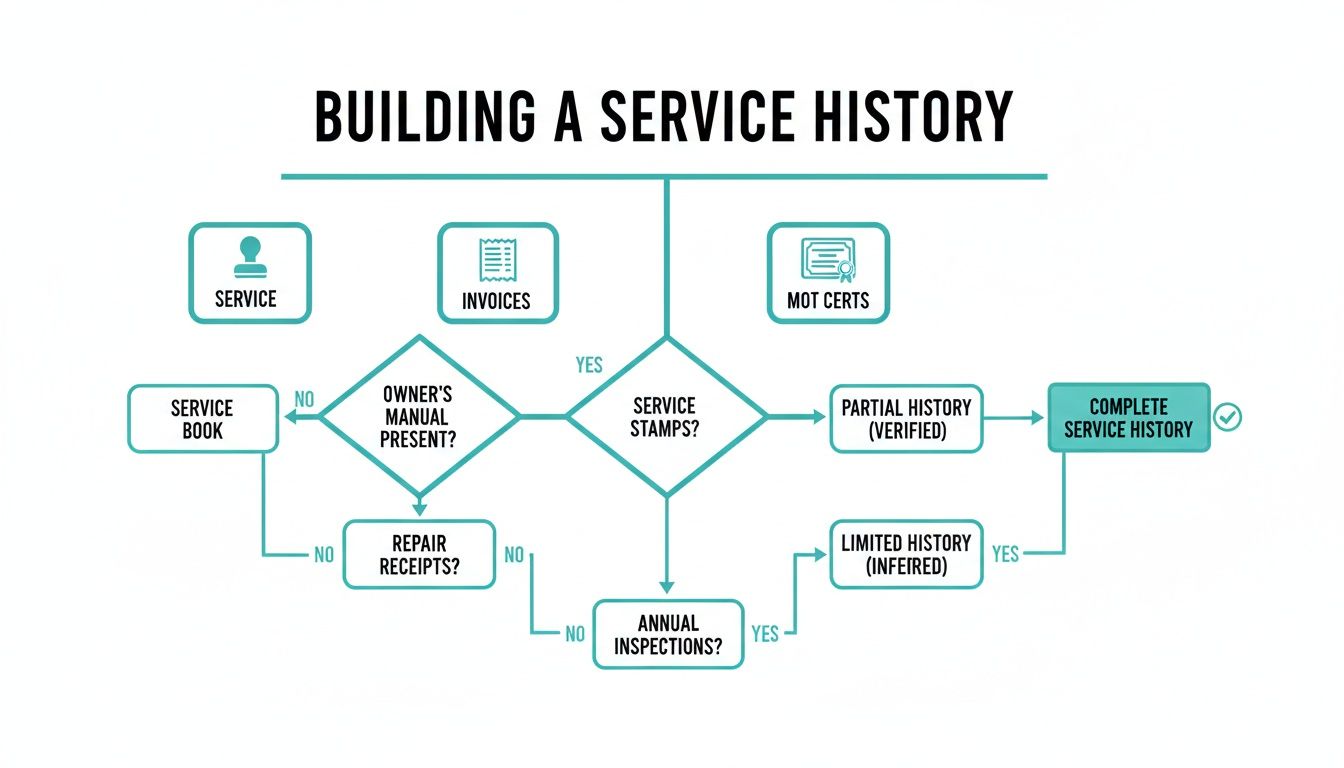
As you can see, a strong history isn't just about a stamped book; it’s built on multiple, interlocking pieces of evidence.
Your Step-by-Step Verification Checklist
Let's start with the easiest win. The government offers a free online MOT history service that is a goldmine of information. Just enter the car's registration number, and you can see its entire MOT history right back to 2005.
What you're looking for is a consistent, believable progression in mileage year after year. Cross-reference the mileage on the service invoices with what's recorded on the MOT certificates. Any sudden, unexplained drops or massive jumps in the numbers should set alarm bells ringing.
Next, it’s time to get on the phone. Any legitimate service invoice will have the garage’s name and contact details on it.
Call the Garages: Pick a few of the garages listed on the invoices and give them a ring.
Confirm the Work: Ask them to check their records and confirm they carried out the specified work on that car (give them the registration number) on that date.
Ask for Details: A genuine garage will almost certainly have the job logged on their system and should be able to verify it.
This simple step is often the fastest way to uncover a completely fabricated history.
Spotting Telltale Signs of Fraud
Finally, it's time to examine the service book itself with a critical eye. People who forge documents often slip up on the small details.
A genuine service history can be the difference between a reliable purchase and a financial nightmare. Verifying every record—from garage stamps to the government’s digital MOT archives—is non-negotiable. This due diligence is what protects your investment.
Look closely at the garage stamps. Do they all look a bit too perfect? Are they all identical in ink colour and applied with the exact same pressure, as if they were all done in one go? Do the signatures from different mechanics over several years all look suspiciously similar? A ten-year-old car with a service book that looks like it was printed yesterday is another major red flag.
According to industry experts, a verifiable full service history is so crucial that its absence can make 40% of used car buyers walk away on the spot. You can discover more insights about vehicle history verification at limited100.co.uk.
The Modern Solution to an Old Paper Problem
We’ve already talked about how much a Full Service History (FSH) is worth and the risks of relying on a stack of flimsy, old-fashioned paper. Let’s be honest, that classic glovebox stuffed with fading receipts and bulky folders is a relic. The constant threat of losing it all to a spilt coffee or fire is a problem that belongs in the past. It’s time to move beyond the paper chase.
The answer is a permanent, secure digital service history. We now have the technology to solve the fragility of paper records once and for all. You can turn that disorganised pile of paperwork into a powerful digital asset that protects your car's value, forever. This isn't some complex task for tech experts anymore; it's a simple, instant process available to every car owner in the UK.
How Smart Technology Ends the Paper Problem
Imagine transforming your car's entire history into a secure, verifiable timeline in less than a minute. Our modern Web Application makes this a reality. It's accessible instantly via browser on any device—there's nothing to download.
We designed the whole process to be completely effortless. You just snap a photo of any service invoice or receipt, and our powerful AI automatically extracts and verifies the data. It intelligently pulls out all the crucial information—the date, mileage, parts used, labour costs, and garage details—and organises it perfectly for you.
Say goodbye to "mystery maintenance" and lost invoices. A digital record means every oil change, every MOT, and every tyre replacement is captured, secured, and instantly accessible, providing undeniable proof of care.
This smart approach gets rid of manual data entry and eliminates the risk of human error. What you get is a perfect, searchable record that you can pull up anywhere, anytime. You can learn more about how we use secure cloud storage to protect your valuable documents for life.
The Core Benefits of a Digital History
Moving your service history online offers so much more than just convenience. It gives you a level of security and permanence that paper simply can't compete with.
Here are the key advantages:
Permanent Security: Your records are shielded by bank-grade encryption and stored safely in the cloud. This means they're protected from physical damage, loss, or theft.
Instant Accessibility: Need to find a receipt or check a service date? You can do it in seconds, from any device. No more frantic digging through chaotic folders.
Enhanced Value: A clean, easily shareable digital report gives potential buyers the ultimate confidence, helping you get the best possible price for your vehicle.
This is all available for a single one-off fee per vehicle for lifetime access. It's a small, one-time investment to permanently protect your car's value and avoid losing thousands of pounds just because of some missing paperwork.
Frequently Asked Questions About Car Service Histories
Let's tackle some of the most common questions UK car owners have about service histories. We'll clear up a few myths and reinforce the key points in a quick, easy-to-read format.
Does a Main Dealer History Matter More Than an Independent Garage?
This is a classic debate. A main dealer history is often seen as the "gold standard," especially for a newer, high-spec, or premium brand car. It signals that no expense was spared.
However, a consistent, detailed history from a reputable independent specialist is just as valuable—sometimes even more so if they're a known expert for your particular make. The real key is the quality and regularity of the servicing, backed up by proper invoices. A complete record from a trusted local garage will always trump a patchy main dealer history.
Can I Service My Own Car and Keep a Full Service History?
While servicing your own car shows dedication, it unfortunately doesn't count as an "official" service history in the eyes of most buyers. The value comes from the third-party verification and official stamp that a professional, VAT-registered garage provides. It’s an independent seal of approval.
That said, you should absolutely keep meticulous records and receipts for any work you do yourself. Store them alongside the professional invoices as proof of your careful ownership. But to protect the car’s resale value, professional servicing is essential.
What Is the Difference Between a Full and an Interim Service?
Think of it like a check-up versus a full physical. An interim service is a lighter touch, usually done every 6 months or 6,000 miles. It covers the basics, like an oil and filter change, to keep things running smoothly between bigger jobs.
A full service is the main event, typically carried out annually or every 12,000 miles. It's a much more thorough inspection, involving a wider range of checks and part replacements according to the manufacturer's specific schedule. A true "full service history" shows that the car has had all its required services—both full and interim—done on time.
Stop letting your car's value fade away with your receipts. Protecting your asset has never been easier. Start your free trial today at autoservicehistory.co.uk and see how a secure digital record can safeguard your vehicle's worth for a single one-off fee.
Written with the Outrank tool